Exercise · Cardio
Stair climber: how to use it properly
The stair climber is a cardio machine that feels like an endless staircase. It mainly works your legs and glutes in a steady effort. It’s a good pick if you want cardio that feels more muscular than a bike or treadmill.
Doable at all 76 gyms GoSet follows
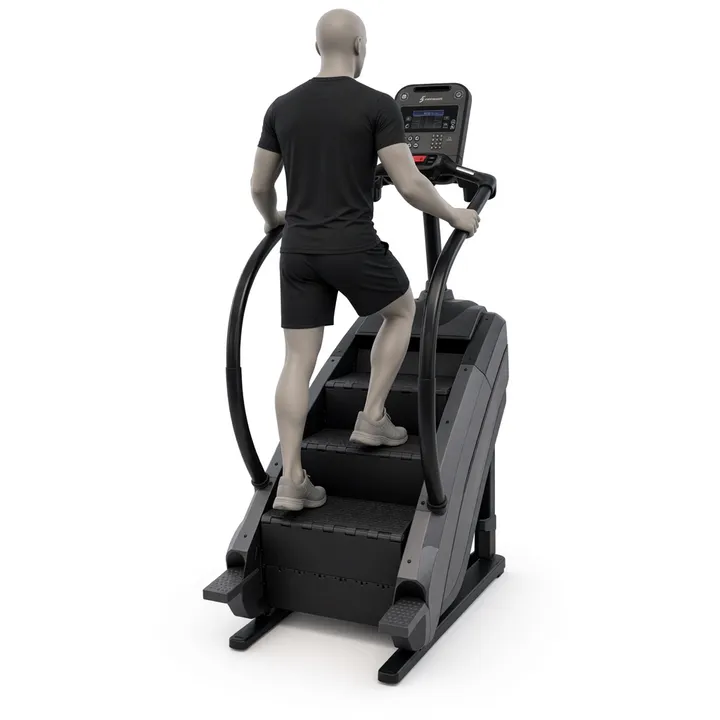
The essentials
- Place your whole foot on each step.
- Touch the rails lightly without leaning on them.
Muscles worked
- Primary
- —
- Secondary
- Quadriceps · Glutes
How to do it
- Carefully step onto the machine while it’s stopped and hold the rails just to get set up.
- Place your whole foot on each step, in the middle, without letting your heel hang off.
- Stand tall, look forward, and relax your shoulders a bit.
- Pick a speed where you fully control each step and don’t have to chase the stairs.
- Climb one step at a time with a smooth, steady motion, keeping your whole foot in contact on every step.
- Hold the rails lightly with your fingertips for balance, without putting your bodyweight on your arms.
Common mistakes
Climbing on your toes only
Instead : Slow the speed down and focus on placing your whole foot on each step. Think about gently touching the step with your heel every time.
Hanging on the rails
Instead : Loosen your grip and hold the rail only with your fingertips. If you feel you have to pull hard with your arms, lower the speed until you can stay upright without hanging.
Going too fast too soon
Instead : Start at a speed where you can keep solid posture and steady breathing. Only turn it up when the movement still feels clean and controlled.
Staring down at your feet
Instead : Keep your eyes mostly forward, slightly down, but not glued to the steps. That helps your back stay more upright and your stride feel smoother.
Coach tips
- Keep a steady, controlled pace, like walking up normal stairs, without stomping on the steps.
- Breathe in a rhythm: for example, inhale for 2–3 steps, exhale for 2–3 steps, and find a pattern that keeps you in control.
- To progress, play with total time first, then with speed, instead of cranking everything up at once.
- If you feel unsteady, use one hand more on the rail until you find your rhythm, then slowly lighten your grip as you gain confidence.
Variations
- Interval climbs: alternate faster periods and slower recovery periods to change the effort, always keeping your whole foot on each step.
- Slower climbs with strong steps: lower the speed and focus on pushing firmly on each step to feel your legs and glutes working more.
Sets and reps
On the stair climber, people often work by time, for example a few blocks of several minutes, with or without speed intervals. Some use it as a short finisher at the end of a workout, others as a longer main cardio session.
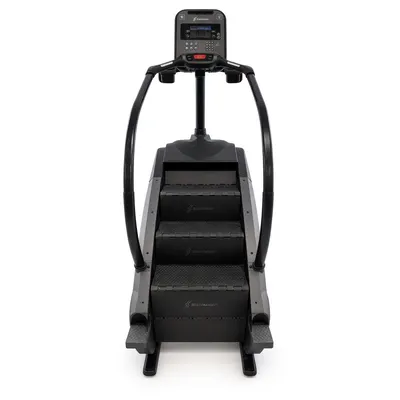
Equipment
Log your Stair climber sets with GoSet
GoSet remembers your last time, starts your rest on its own and notes your records. Even with no signal in the basement. Coming soon to iPhone and Android.
Common questions
Do I need to look at my feet while climbing?
You can glance down at first to feel safe, but try to keep your eyes mostly forward. It helps you stay more upright and stable on the machine.
Can I let go of the rails completely?
Yes, if you feel comfortable and in full control at that speed. Start by holding lightly, then see if you can let go with one hand, then both, without your posture falling apart.
I get tired quickly on the stair climber, is that normal?
The stair climber asks a lot from your legs and glutes, so it’s normal to feel the burn come on fast. If you’re too winded or it burns too much, slow down or take a break.
Should I bend my knees a lot on this machine?
Bend enough to clear the step fully, but don’t force an exaggerated deep bend. Keep a natural stair-climbing motion, with your whole foot solid on every step.